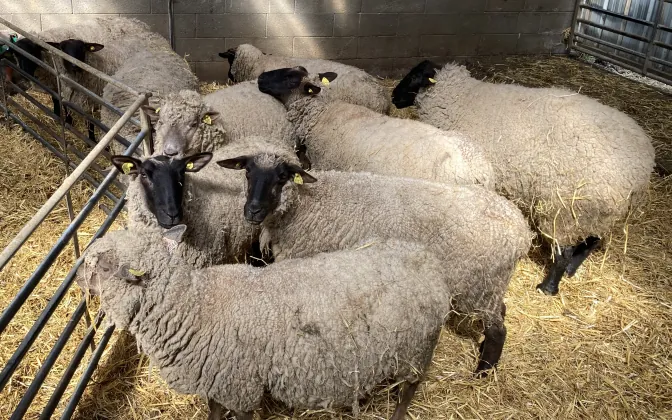
Three lambs of quite distinct origins, and of a flavour beyond compare.
Le Grévin
Salt-marsh lamb, pré-salé
Not every lamb can claim it. Pré-salé lamb answers a strict specification: a defined geographic area, parents of grévine stock, every birth declared to the association, veterinary follow-up, and slaughter at sixty days at the earliest.
The decisive condition is the grazing: the ewes must graze at least 230 days a year on the salt meadows. Those meadows run through the bay of Mont-Saint-Michel, from the north to the south of the Cotentin, over more than 2,000 hectares.
Sixty-seven plant species share the levels of vegetation there: sea meadow-grass, cord-grass, sea purslane. It is that salt grazing that gives the meat its taste, with nothing added.
Pauillac lamb
Raised chiefly on its mother’s milk, for seventy-five days at most, for a carcass weight of 11 to 15 kg.
The meat is white to pale pink, with a flavour of its own: a lamb at the top of the range. It was on President Loubet’s menu in 1903, and the 1938 Larousse gastronomique called it the most perfect milk-fed lamb there is.
PGI
Pyrenean milk-fed lamb
From mid-June to September the ewes, of hardy local breeds (Manech black-face, Manech red-face, Basco-béarnaise), go up to the high Pyrenean pastures and the rich grazing there.
The milk-fed lamb is born down in the valleys, between November and May. Raised on a single farm, for forty-five days at most, it feeds on nothing but its mother's milk, at the udder.
That strictly milk diet gives meat that is pale, tender, soft and fragrant.
Want to taste it?
Come and choose in the shop
What we have changes with the seasons and with the dry-aging. The surest way to know is to drop in, or to call.